LLC Privacy Is Not a Tax Strategy—It Is an Operating Discipline
Reducing personal information in LLC public records may be possible, but it does not remove IRS reporting, bank verification, or tax obligations. A sound structure starts by separating business risk, assets, and bookkeeping.
Kwon CPA
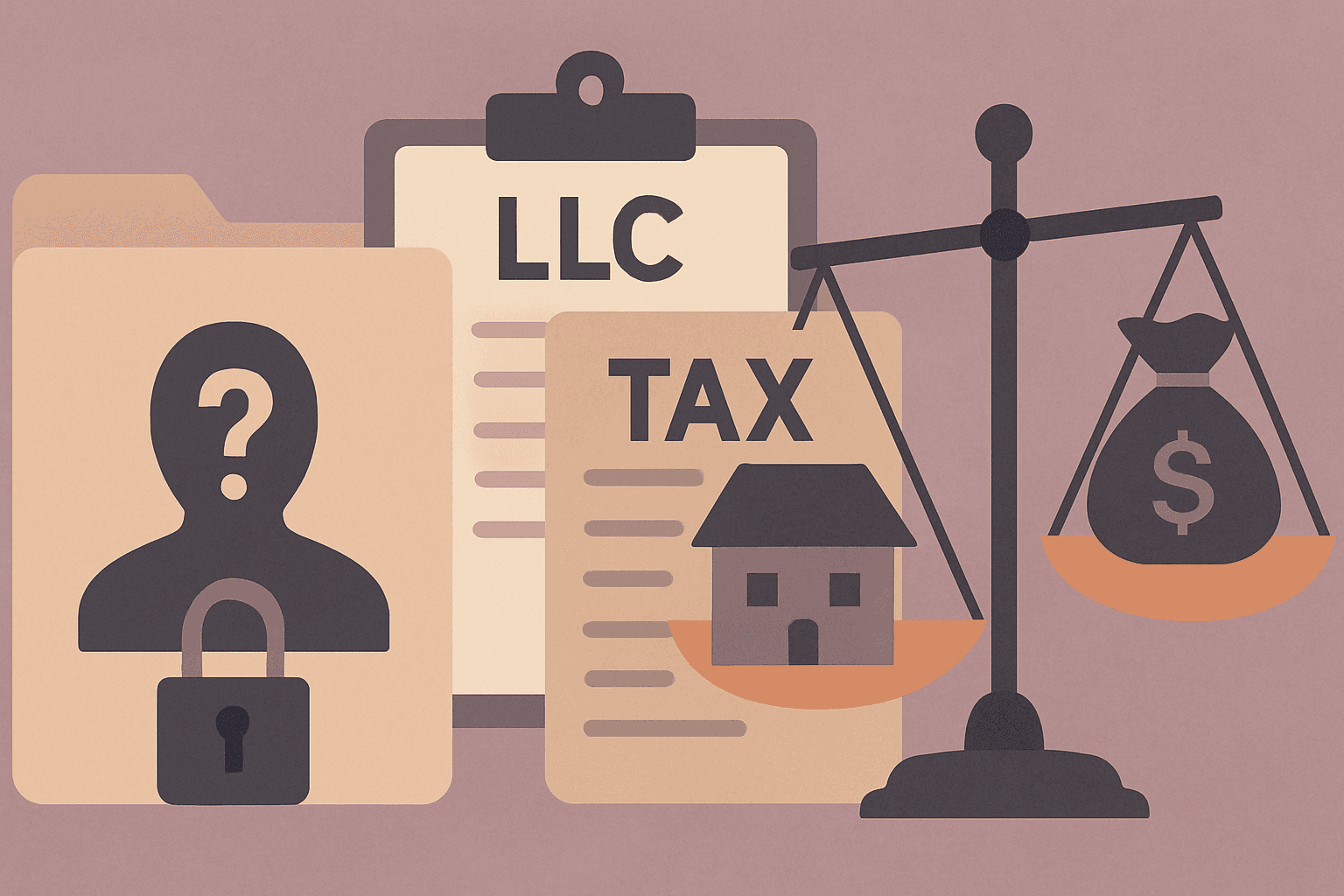
Many owners are surprised to find their name, home address, or company role on a state business-search website after forming an LLC. For restaurant owners, laundromat operators, cleaning companies, contractors, and retailers, that concern often becomes a bigger question: “Can an anonymous LLC reduce my taxes and protect me from a lawsuit?”
Let’s draw a clear line. Limiting personal information in public filings is a privacy design decision. It is not a way to hide income, avoid tax, or conceal the real owner from the IRS, a bank, or your CPA. The practical value of an LLC is broader: keeping operating risk, long-term assets, and personal money separate—and proving that separation through records and tax filings.
1. What an “anonymous LLC” can—and cannot—do
States do not ask for the same information on formation documents. Some states allow an LLC to file without publicly naming every member or manager, while others require more information. A commercial registered agent and business mailing address can also help keep a home address off public-facing filings. Those choices manage public search results; they do not erase your identity.
When applying for an EIN, the IRS requires accurate information about the true responsible party. When opening a bank or brokerage account, expect requests for beneficial-owner information, identification, the EIN confirmation, and an operating agreement. Federal and state income-tax filings must also reflect the real ownership and income arrangement. A one-owner LLC, a partnership-taxed LLC, and an LLC that elects corporate taxation can have very different forms and deadlines.
FinCEN beneficial-ownership reporting rules have changed more than once. Under rules in effect following changes in March 2025, U.S.-formed domestic entities have generally been exempt from BOI reporting, but rules, exceptions, and interpretations can change. Confirm current FinCEN guidance and your state’s filing requirements before forming an entity or changing ownership. Public-record privacy and exemption from government reporting are not the same thing.
Keep your public footprint private where lawful, but keep your tax records completely transparent.
2. For tax purposes, where you work matters more than where you form
Forming an LLC in a state known for more private public filings is not automatically a cost-saving move. Suppose you operate a café in California, with California employees, a California storefront, and California sales. A Wyoming LLC may still need to register in California as a foreign LLC. That can create filings, registered-agent costs, and annual compliance in two states. California’s minimum franchise tax and potential LLC fee also need to be reviewed.
The same principle applies in New York, New Jersey, Texas, Georgia, and elsewhere. The key state is usually where you have a location, sign contracts, employ people, and serve customers. An out-of-state holding-company structure may deserve consideration for certain real-estate or multi-entity situations. For one neighborhood restaurant or one cleaning crew, however, it may simply add administrative cost.
Start with these tax and operating questions:
- In which state is revenue actually earned?
- Where do employees work, and are payroll withholding and unemployment accounts in place?
- Do you need sales-tax registration or local food-and-beverage tax registration?
- What assets will the LLC hold, and who reports the income from those assets?
- If you have multiple LLCs, are their books, accounts, contracts, and insurance truly separate?
Income and employment obligations tied to the state where you actually do business do not disappear because the LLC was formed elsewhere. Operating without required registration can lead to penalties, delays in contracts or banking, and problems during a dispute.
3. Do not place risky operations and protected assets in one account
The most common operational failure is not the LLC name—it is commingling. Imagine a restaurant LLC pays the owner’s apartment rent, holds a brokerage account for spare cash, and then an employee is involved in a delivery accident. The cash and investments that were meant to be protected are sitting inside the same entity as the operating exposure. At tax time, it is also much harder to determine whether payments were business expenses, owner draws, distributions, or loans.
Real estate needs its own review. Rental property carries specific risks: slips and falls, water intrusion or mold, tenant disputes, and major repairs. Putting multiple properties and an operating business into one LLC can allow one problem to affect a wider pool of assets. Whether each property should have its own entity, whether a local entity is required, and how much umbrella insurance makes sense depend on the property state, loan documents, and legal advice.
LLC protection is not automatic. A personal guarantee can create personal exposure within its terms. Mixing personal and company funds, failing to document decisions, or using the company account as a household wallet makes the separation harder to defend. Even a state known for stronger LLC protections does not guarantee the result in every creditor situation. State law, the operating agreement, cash movement, insurance, and contract terms all matter in a real dispute.
4. Build the operating system within 30 days of formation
A new LLC does not protect much if the documents go into a drawer and daily operations continue as before. The following work supports tax filing, banking, insurance claims, a future sale, and audit readiness.
- Save formation records and an operating agreement that match the real owners, managers, and signing authority.
- Apply for an EIN and provide the IRS with accurate responsible-party information.
- Open LLC-only bank and card accounts, and route all business revenue and expenses through them.
- Set up bookkeeping categories for owner draws, payroll, business expenses, loans, capital contributions, and potential distributions.
- Use the LLC’s exact legal name on contracts, invoices, leases, and insurance policies.
- Put annual reports, registered-agent renewals, state tax filings, and payroll-tax deposits on one compliance calendar.
For a contractor, confirm that the legal entity name on job contracts matches the name on certificates of insurance. For a cleaning company, invoice customers through the LLC rather than under an individual owner’s name. For a café or retail store, verify that POS deposits go to the company account—not a personal account. These simple habits reduce the work of reconstructing profit, expenses, and deductible items at year-end.
- Keep a separate bank account, books, card, and contracts for each operating LLC.
- Record money moving between owner and company as a contribution, draw, or documented loan.
- Confirm registration and tax duties first in the state where business is actually conducted.
- Provide inaccurate ownership information to the IRS or bank in the name of privacy.
- Run operations, rental property, personal investments, and family expenses through one LLC.
- Form an out-of-state LLC while skipping registration, payroll, or sales-tax obligations where you operate.
5. Three items to review before adding another entity
LLC privacy touches legal, tax, banking, and insurance issues. A basic online formation package rarely answers the full question for your industry and assets. If you have co-owners, shared marital assets, personal guarantees, rental property, or sales in multiple states, map the structure before you file.
First, review three months of money movement between your personal and business accounts. Second, list the risks and assets connected to each business. Third, put each entity’s federal and state returns, payroll taxes, sales taxes, and annual reports on one schedule. Only then can you compare whether a separate LLC, a holding company, or a corporate tax election has a real benefit after cost and upkeep.
Kwon CPA can review whether the structure is practical to maintain from a bookkeeping and tax-reporting perspective. For asset-protection law and litigation strategy, consult a qualified attorney in the relevant state. A strong structure is not the one that looks most complicated. It is the one you can follow every month.
Next step
How would this apply to your business?
Don't just read it. In 30 minutes we'll look at where you stand and what to clean up first.
Request a 30-minute consultation