The Fed and Your Shop: Turning Rate Headlines Into Cash Flow
When the Fed changes how it fights inflation, it eventually shows up in your loan payments, your customers' wallets, and your bank balance. Here are the numbers an owner actually needs to watch.
Kwon CPA
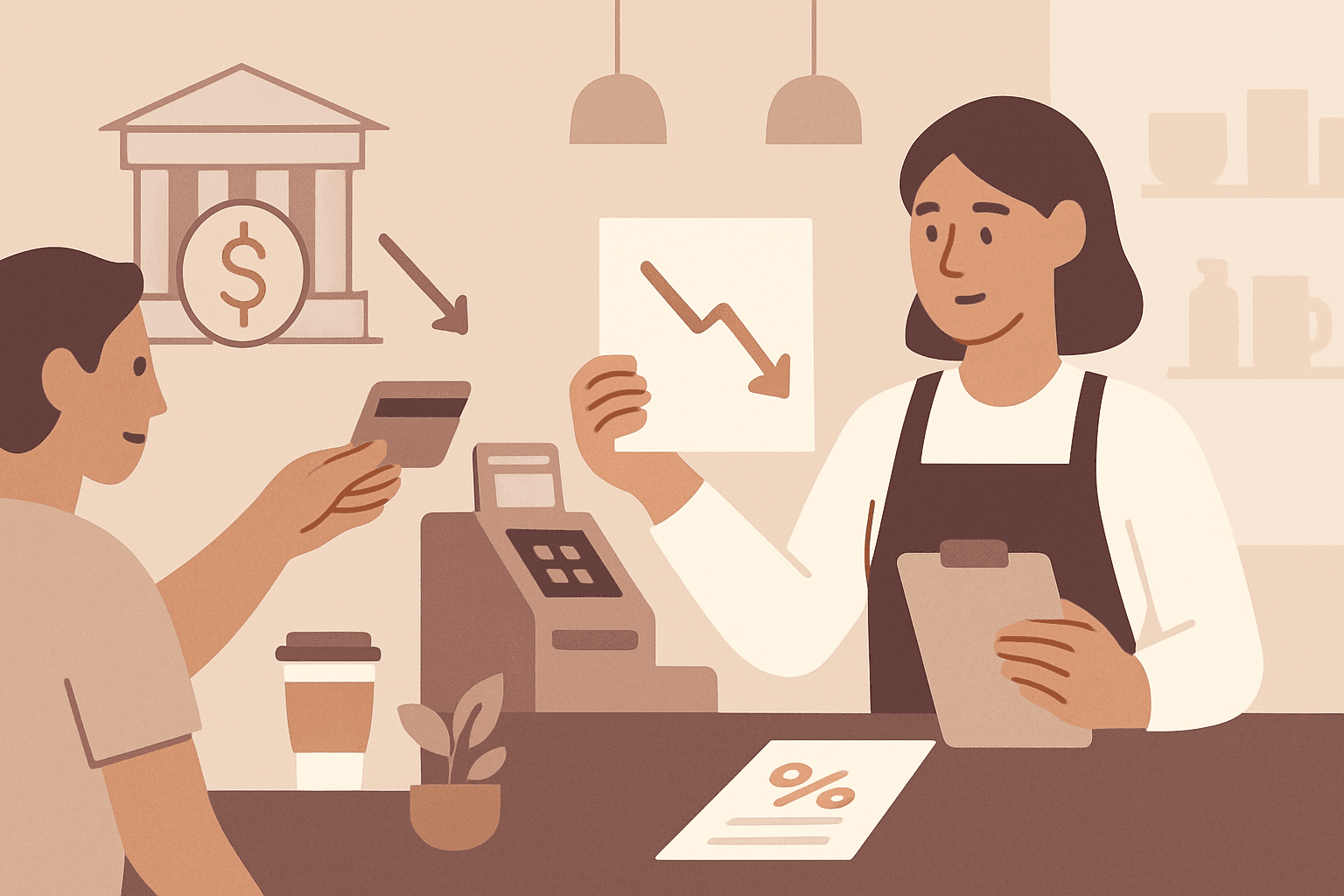
When the news says "the Fed found a new way to lower inflation," many business owners move on quickly. Washington can feel far from your counter. But the Fed's decision to raise or lower rates lands — usually within six months to a year — on your loan payments, your customers' spending, and your account balance.
This isn't an economics lecture. It's a guide to translating the headline into the language of your cash flow.
What the Fed Does, in One Sentence
When prices climb too fast, the Fed makes borrowing money more expensive to cool the economy down. In plain terms, it raises the "price of money." When loans cost more, people delay big purchases — homes, cars, eating out — demand drops, and price increases slow.
The catch is that this "cooling" can affect your business too. A diner skips a meal out, a laundromat regular comes every other week, a construction order gets postponed. The Fed fighting inflation also means somebody's revenue is shrinking.
The Fed's rate decision isn't Washington news — it's a number that hits your bank account six months later.
Look Here First: Variable-Rate Debt
Rate news reaches your variable-rate loans fastest. Business lines of credit, some SBA loans, card balances, and many equipment leases are tied to a benchmark rate.
Say you're carrying $50,000 on a variable rate and it climbs from 8% to 9.5%. That's roughly $750 more in interest a year — about $60 a month. Small on paper, but in a thin-margin business, that amount still matters.
- Write down every loan, lease, and card, and mark each as "fixed" or "variable."
- For the variable ones, note the current rate and monthly payment.
- Calculate what one extra percentage point adds to your monthly cost.
- If the load is heavy, ask your bank about converting to fixed or refinancing.
When you have spare cash to pay down debt, start with the most expensive, variable-rate balance. That's usually your business credit card.
When Customers' Wallets Get Thinner
When rates stay high, customers turn cautious. It shows up differently by trade.
- Restaurants & cafes: The check size drops first. People skip the dessert or extra drink and cut back on dinner out even if lunch holds.
- Laundromats & cleaning: Visit frequency falls — weekly becomes every other week.
- Retail: Impulse buys disappear; only the essentials get bought.
- Construction & repair: Big projects get postponed, only urgent fixes come in.
When sales dip, don't slap on a big price hike — that pushes customers out faster. Small and frequent is safer.
- Adjust 2-3 popular items by 25-50 cents
- Quietly reflect cost increases on the affected items
- Offer combos or add-ons that lift the check size
- Raise the whole menu 10% at once
- Post a big "due to inflation" sign
- Start with the item customers love most
The Numbers to Prepare
In a cooling economy, your benchmark is simple: enough cash to survive three months even if sales wobble.
If your monthly operating cost is $20,000, your reserve target is $60,000. If you can't build it overnight, move a fixed percentage of sales into a separate account each month. The key is keeping it in an account that never mixes with your operating cash.
Do This Now (This Week)
You can't control the news, but you can control how ready your business is.
- Sort every debt into fixed vs. variable and calculate the variable burden.
- Make a plan to pay off the most expensive variable-rate debt first.
- Compare the last three months of check size and visit frequency to see if customers are already pulling back.
- Set a reserve target (three months of operating cost) and start an automatic monthly transfer.
- Pick in advance the items you'll adjust in small, frequent steps.
Rate headlines feel unsettling because they feel distant. But once you put those five things on paper, the headline becomes easier to understand: it is no longer just economic news, but a set of numbers that can affect your cash flow, pricing, debt, and reserves.
Next step
How would this apply to your business?
Don't just read it. In 30 minutes we'll look at where you stand and what to clean up first.
Request a 30-minute consultation